Heat is the real constraint
Before a chip is selected, before clock speeds are negotiated, before a memory bus is widened, an engineer draws a box. Not a logical box — a physical one: a specific volume of plastic and metal, designed for a living room shelf, expected to run quietly enough that a television's audio can cover it. That box defines the thermal budget, and the thermal budget defines the machine.
The relationship runs in one direction. Power consumption and heat output scale together; a chip drawing more watts produces more heat, and that heat has to leave the enclosure before it raises the die temperature past the point where the silicon throttles itself or fails. The question is always how much heat the cooling system can remove, continuously, under a sustained gaming load — because gaming loads are not bursty like a laptop's office workload, they are relentless. A platform-holder commissioning a new generation cannot simply choose the fastest chip available; they choose the fastest chip the enclosure can cool.
The enclosure itself is the product of injection moulding ↗ tooling committed early in development, before final silicon is locked. Tooling lead times are long enough that the outer shell — its vent geometry, its internal partition walls, the paths air travels from intake to exhaust — is functionally decided before the board layout beneath it is finalised. This creates a genuine constraint: the thermal path is not designed around the chip, the chip is selected to fit the thermal path.

The budget in numbers and noise
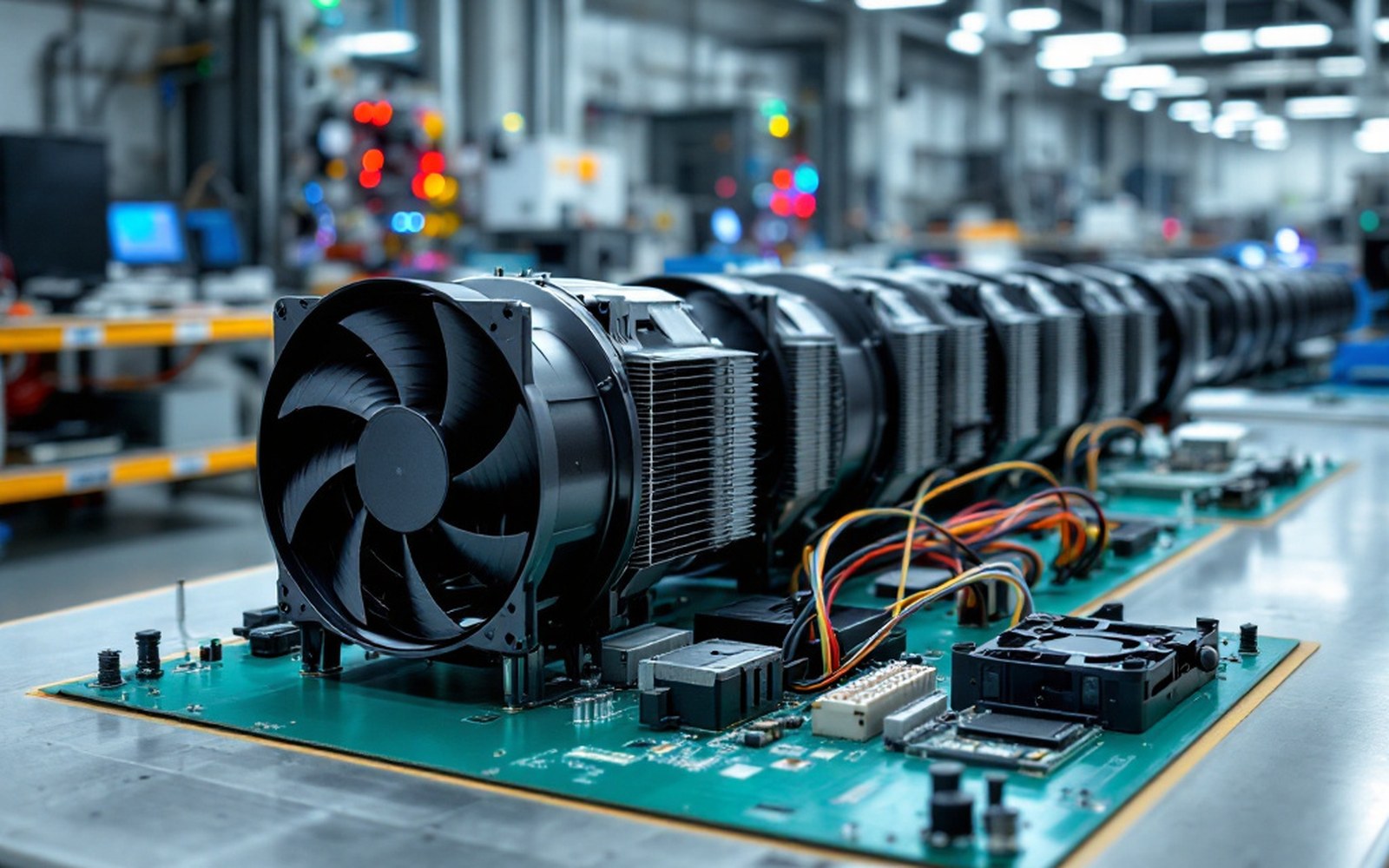
A heat-pipe and fan assembly of a given size, spinning at a given speed, can move a given number of watts. Spin the fan faster and the watts increase — but so does acoustic output, and consumer expectations place a ceiling on that too. Platform-holders have published their own acoustic targets across generations, because a console that sounds like a turbine in a quiet room damages the product in a way a benchmark number cannot recover. The acoustic ceiling becomes a secondary constraint on top of the thermal one, and the two together close the design space considerably.
What remains after those ceilings are established — watts available, noise permitted — is the thermal budget ↗: the number the chip, the board, the storage and the memory system collectively must stay inside. Distribution across components matters. A faster GPU draws more, leaving less headroom for the CPU; a higher-bandwidth memory configuration generates its own heat at the package. System-on-chip designs that integrate GPU, CPU and memory controller on a single die can improve this, because integration reduces the total power needed for a given level of performance, but the fundamental arithmetic of watts-in and watts-out remains.
The seven-year span of a console generation is relevant here. As noted in the same box, understood better each year, developers accumulate deep knowledge of a fixed specification, and games late in a generation extract performance that launch titles could not. That extraction comes partly from software optimisation, but the thermal ceiling does not move. The headroom a studio finds over time is algorithmic, not thermal — the silicon can never sustainably exceed what the cooling system can remove.
This is why mid-generation hardware revisions — a smaller, quieter, lighter model released two or three years into a cycle — typically involve a die shrink. Smaller process nodes produce the same computation at lower power, which means the same thermal budget now has slack in it: the fan can run slower, the enclosure can be shallower, the product becomes cheaper to manufacture without sacrificing the specification that developers are already building for. The thermal budget stays constant; it is the chip that moves to meet it.
The enclosure, the acoustic limit and the power budget are set years before a console appears on a shelf. Every number printed on the specification sheet — teraflops, memory bandwidth, storage throughput — exists inside that envelope. The box decides the machine.